
The Three-Speed Trap: Building Products in an era of Inifinte Code
How AI is creating an unprecedented speed mismatch that's breaking traditional product management—and what to do about it.


Listen to a summary of the article here:
This one is a little technical. Inside baseball. Everyone can follow but it will mean more to practitioners :)
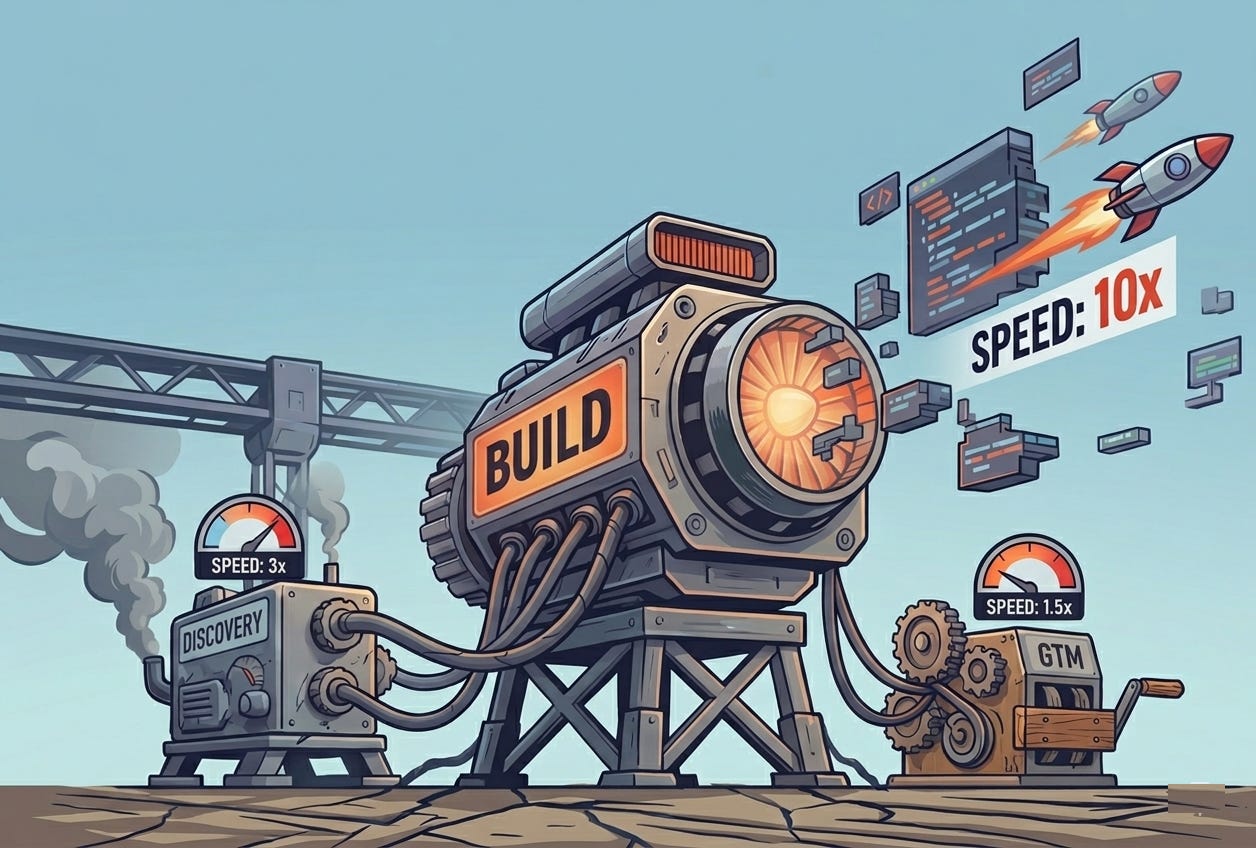
Every Product Builder’s Nightmare
A senior PM posted a panicked message on Reddit: their CEO had bypassed the entire product team, coded a solution with the CRO over the weekend, built a landing page, and started pre-selling—all while the product team was “stuck in discovery.” It felt like a unique threat to their value within the company, especially if it worked (spoiler: it didn’t).
This isn’t about one rogue executive. This is the new reality when building software becomes as accessible as writing an email. We have entered the era of infinite code.
The Three-Speed Problem
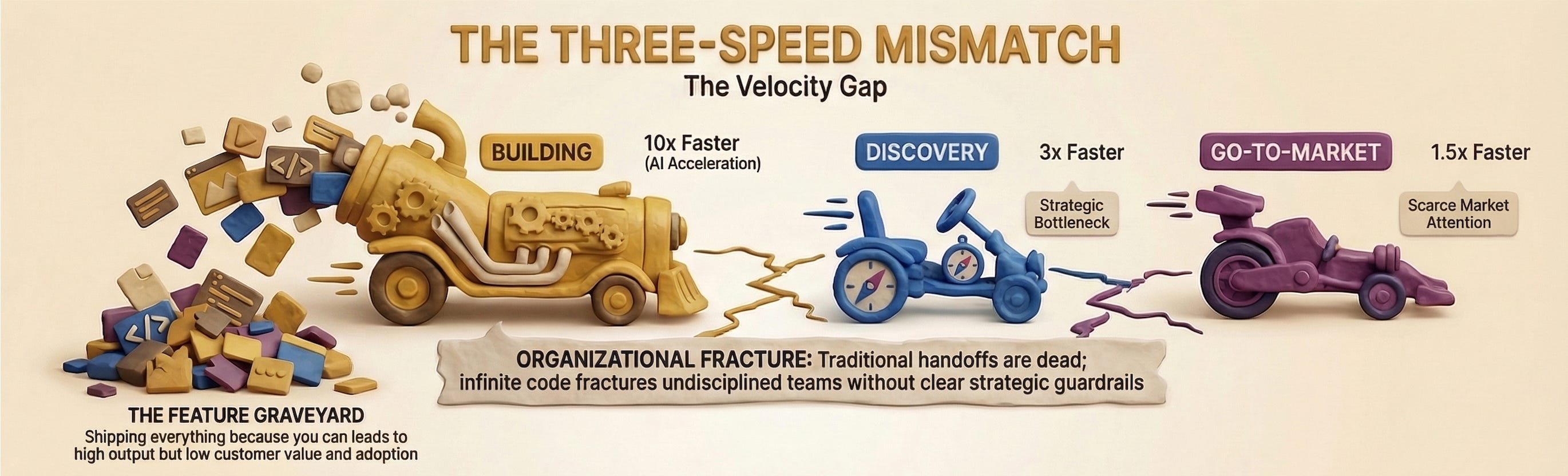
AI is accelerating different parts of product development at dangerously different rates:
Discovery/Listening: 2-3x faster (AI feedback analysis)
Building: 10x faster (AI-powered development)
Go-to-Market: 1.5x faster (content creation accelerates, attention remains scarce)
It’s like driving a car where the engine goes 200mph, the steering responds at 50mph, and the brakes work at 20mph.
Research validates this mismatch. GitHub studies show massive improvements in developer productivity with AI tools. We have been using Claude Code assiduously to better prepare our advisory and investment clients and founders for the near future, and the productivity gains for non-coders feel like +600%. We can build faster than we can validate. We can ship faster than we can educate markets.
As you can imagine, there are downsides
Low Feature Value and Feature Graveyards: Teams ship everything because they can. One team I know shipped 47 features in a quarter. Customers used three. Not everything that can be built is valuable.
More Organizational Chaos: If everyone can code, who does what? Traditional handoffs—PMs write specs, engineers implement—are dead. Most teams haven’t figured out what replaces them. We’ve long asked product teams to work on the invisible stuff - clear vision/mission, actionable northstar and sub goals, key strategies, and guardrails, clear objectives. Decision rights and decision logs. Rituals that reinforce these things while being loose enough to evolve. if people are involved, some lightweight structure is needed. Infinite code will fracture undisciplined creative organizations.
Frustrated Leadership: CEOs promised 10x gains, but see marginal business outcomes, customer adoption. There is still a competitive market out there, and not everything catches fire. So they take matters into their own hands…if they are that kind.
The Solution is Simple - Accelerate Everything
The instinct could be to slow down building to match other speeds. This is backward thinking that will get you steamrolled.
Instead, accelerate discovery and GTM to match building speed, while completely reimagining how you use that velocity.
Supercharge Customer Listening
The old way: Three months analyzing feedback manually.
The new way: AI tools like Thematic automatically identify themes across massive text volumes without manual tagging, reducing analysis time by 98%.
The winning workflow:
Centralize all feedback streams into one AI-powered system
Query your data conversationally: “What makes customers cancel?” “Which features drive retention?”
Connect insights to action: integrate with development tools so the system can query aggregated feedback, isolate top issues by itself, and write PRDs and first-draft code
As one product manager notes: “We built our internal AI analysis tool, which allows us to automatically collect, analyze, and address all concerns... we can close the feedback loop efficiently, almost in real-time.”
Anthropic’s Claude Code has been shipping features furiously in the last month. And it finally occurred to us why: When your product has a conversational interface talking to a human-level intelligence, customers will ‘confess’ what they need to it frequently.
It’s fairly easy to vacuum up customer suggestions, sort them, find the best ideas, and implement them. Especially when some new features are simply new prompts or new skill definitions. They’ve been hinting about Claude Code self-improving by building its own new features for some time now
Revolutionize Discovery
Build a multi-channel discovery engine running 24/7:
Community-Powered Discovery: One Discord with 1,000 engaged users validates ideas in hours, not weeks.
AI-Enhanced Research: Use AI research intelligence tools to synthesize social mentions, competitive intelligence, and historical patterns at scale.
Continuous Feedback Farming: Embed discovery everywhere—in-app surveys, AI session analysis, real-time experiments.
The goal: build and test 100 ideas, where you used to test 10.
Master the New Building Paradigm
The reality is: If you can’t build a basic prototype in code, you can’t product manage in 2025.
The era of 20-page PRDs is over. Your new PRD is a lightly annotated (why it matters) working prototype that engineers can run. Use Model Context Protocol (MCP) to formalize the design language and system, even the platform code conventions so rewrites are minimal.
Then use 10x building speed from developers strategically:
Polish: Create delightful experiences, not just functional ones
Ambition: Solve entire customer workflows, not just slices
Tech Debt: Rebuild old non-agentically designed systems with AI at the core
Embed in Go-to-Market
Traditional product-marketing handoffs are too slow. Embed yourself directly in revenue operations:
Join weekly sales calls for real-time customer feedback
Define “market-ready” (not just “feature-complete”) criteria
Use AI to generate sales content and launch campaigns
The New Team Structure: Hyper Creator Shipyards
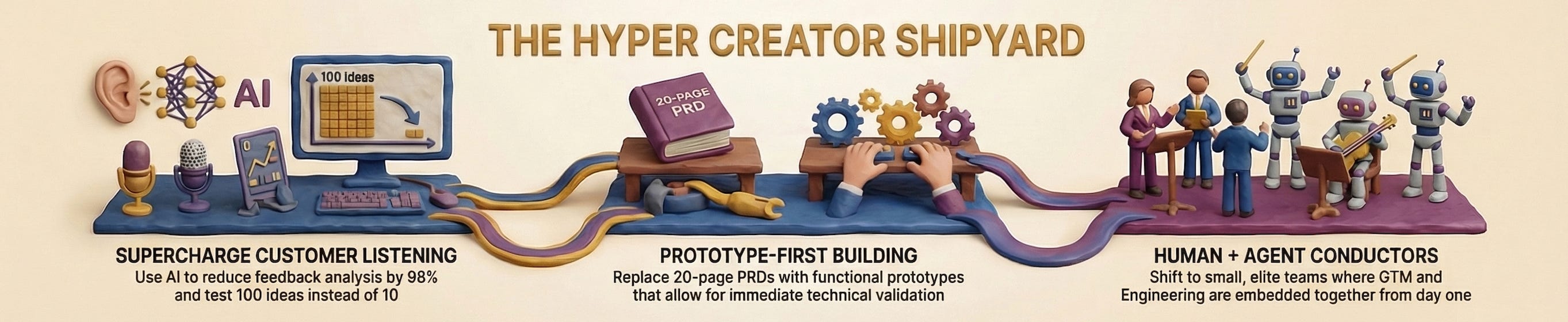
Traditional: PM owns discovery → Designer creates mockups → Engineers build → Marketing launches. This won’t cut it anymore… soon.
New Shipyard Model:
Core Hyper Creator Team: 4 product engineers (former PMs and Developers) working with specialized humans and agents. We become highly experienced human + agent conductors. The prior experience is key - AI is not perfect yet.1
Embedded GTM: Sales/Marketing sits with the team from day one. Things move too fast not to.
Discovery Ops: New roles managing continuous insight infrastructure.
Success requires: clear goals + autonomy + complete skill sets + customer-facing teams as core partners.
Reclaim Product Leadership
The CEO codes because they see stagnation amid abundance. Your job isn’t to gatekeep—it’s to orchestrate all three speeds into continuous value delivery.
Companies that win won’t just adopt AI tools—they’ll fundamentally restructure how product, engineering, and GTM work together. They’ll build shipyard teams that discover, build, and ship at the new speed standard.
The tools exist. The methodologies work. The question is: will you use them to reclaim product leadership, or watch your CEO ship features while your team debates PRD formatting?
In the three-speed world, surviving product leaders won’t slow down AI—they’ll accelerate everything else to match.
🔍 Want to dive deeper?
Check out our book BUILDING ROCKETSHIPS 🚀 and continue this and other conversations in our 💬 ProductMind Slack community and our LinkedIn community.
🎧 Prefer to listen? Check our podcast below ↓
🎥 YouTube → Click Here
🎵 Spotify → Click Here
🎙️ Apple Podcasts →Click Here
Product Sense, Taste making, Performance, Judgement. All come with experience, all still valuable.