
The Era of Infinite Code: What’s Going to Happen When Building Stops Being the Bottleneck to Value?
A new asymmetry is emerging in product development. Code generation has became effectively unlimited. Everything else didn’t.


We’ve been watching the numbers coming out of GitHub, and something unprecedented is happening.
AI now writes 46% of all code that top developers commit. At some companies, it’s hit 61%. Copilot users complete coding tasks 55% faster—we’re not talking about a marginal improvement here. We’re talking about developer pull request times dropping from 9.6 days to 2.4 days. That’s a 75% reduction in development cycle time.
Over 20 million developers are using AI coding assistants today—a 400% increase in just one year (and a lot of money for Anthropic, the frontrunner with Claude Code). And 90% of Fortune 100 companies have adopted these tools as standard infrastructure. This isn’t experimental anymore. This is the new normal.
And while we’re all celebrating these productivity gains, we’re missing the bigger story. The real story isn’t about code getting faster. It’s about what happens when one part of product development accelerates dramatically while everything else stays roughly the same.
We’re entering the era of infinite code. And most product organizations are completely unprepared for what that means.
The Unprecedented Acceleration
Let’s be clear about how unprecedented this is. The software development market is growing from $532 billion in 2024 to a projected $1.45 trillion by 2033. But that growth is being driven by a fundamental shift in how we produce software.
Consider what’s happening:
84% of developers now use AI tools regularly
Development teams report 10-30% productivity improvements on average, with active Copilot users seeing up to 81% gains
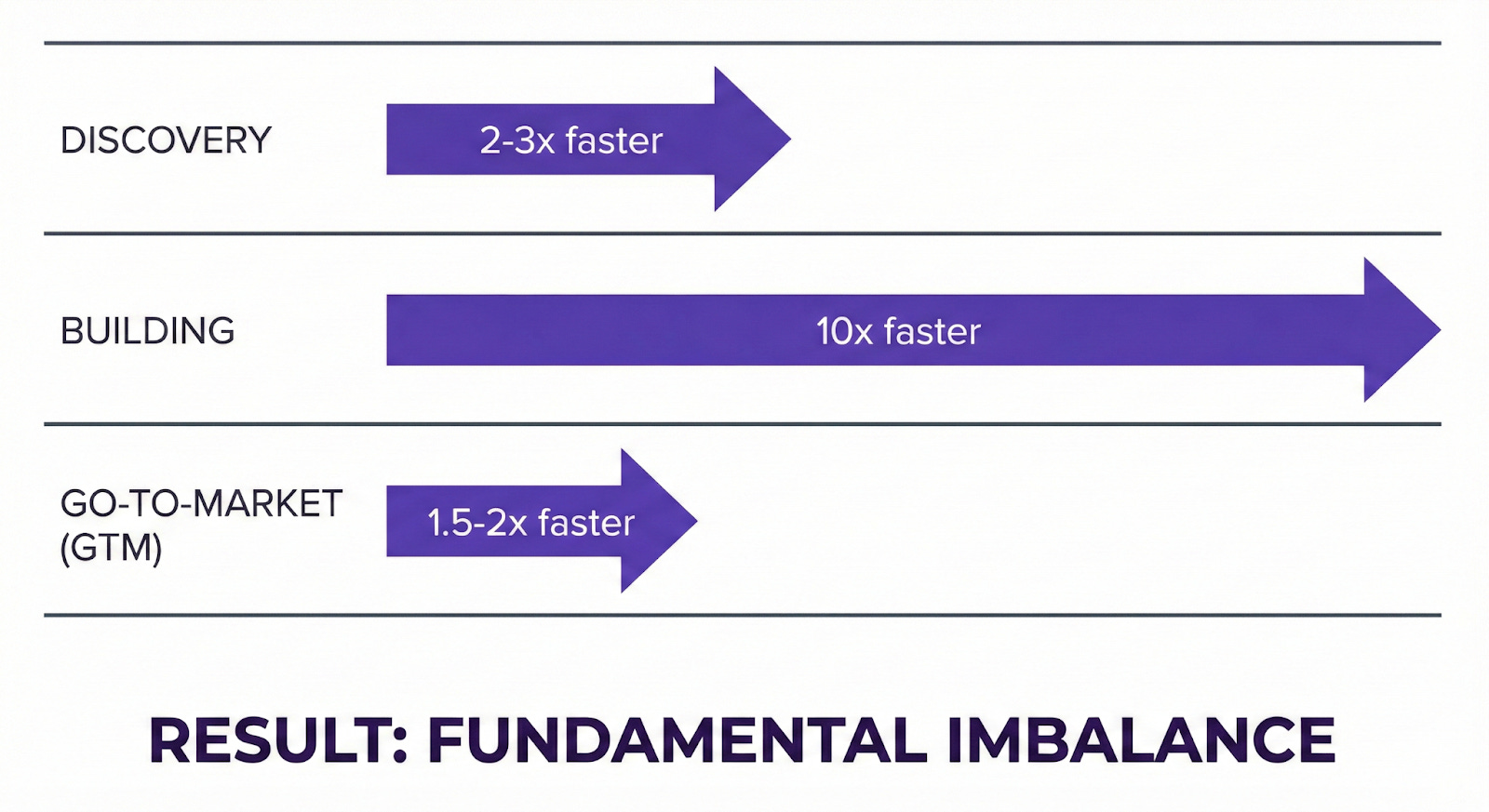
There’s some critical insight buried in these numbers: this acceleration isn’t uniform across the product development lifecycle. We’re seeing a 10x acceleration in building, but only 2-3x in discovery and maybe 1.5-2x in go-to-market.
This creates an equation that doesn’t balance: A three-speed problem.
What “Infinite” Actually Means
When we say “infinite code,” we don’t mean literally infinite, obviously. What we mean is that code capacity has become effectively unlimited relative to historical constraints.
Think about it: for the last 40 years, engineering capacity was the primary constraint on what we could ship. Product teams spent months prioritizing features because we couldn’t build everything. We created elaborate frameworks—RICE scoring, value vs. effort matrices, roadmap planning rituals—all designed to manage scarcity.
That scarcity is disappearing. A CEO can now sketch an idea in the morning and have a junior developer crank out a working feature that is consistent with product design language by lunch. What used to take a sprint team weeks can now be prototyped in hours.
But—and this is the critical point—the rest of the system didn’t speed up proportionally. You still need to:
Understand if this solves a real customer problem
Figure out how it fits with your strategy
Test whether it actually works for users
Train your sales team on it
Create documentation
Ensure it doesn’t confuse or overwhelm customers
These constraints haven’t disappeared. They’ve just become more visible.
WHAT BECOMES ABUNDANT VS. RARE
The New Bottleneck Isn’t Technical, it’s Judgement
Here’s what we’re seeing happen in real organizations:
Scenario 1: The Overnight Feature A CEO “vibe codes” a feature overnight. They show up at the product meeting with a working prototype. The CRO’s team sees it and puts up a landing page because they’re incentivized on the pipeline. The feature gets announced before anyone checks:
Does this align with our strategy?
Have we tested this with actual users?
Will this confuse our current customers?
Does this create technical debt?
Can our support team handle this?
The answer is often “no” across the board. But the feature is already live. Oops.
Scenario 2: The Junior Developer A junior developer learns how to use Cursor or GitHub Copilot effectively. They get excited and build three new features over the weekend. Monday morning, they show up asking, “Can we ship these?”
The answer isn’t just “great effort!” The answer is a series of questions:
Did you think through the edge cases?
How does this fit the mental model we’re building?
What happens to users who don’t need this?
Have you considered the support burden?
Is this creating parallel paths in the UI?
The pattern is clear: infinite code without infinite judgment creates chaos.
What Product Sense Really Means Now
We don’t particularly like the term “product sense”—it’s often used as a vague code word for something we can’t quite articulate about the primacy of product managers. But in the era of infinite code, it becomes critically important to name what we mean.
Product sense is:
The ability to say “no” to features that are technically impressive but strategically wrong.
The judgment to know when “more” is actually “worse”.
The discipline to maintain simplicity when complexity is free.
The empathy to understand that customers need time to absorb changes.
The courage to delete features even after they’re built.
When anyone can code anything, someone needs to decide what should exist.
This isn’t gatekeeping for its own sake. It’s recognizing that customer confusion, support burden, and product complexity are real costs—costs that don’t show up in pull request metrics or code generation statistics.
Think about fashion. When production became cheap (fast fashion), the industry didn’t become less hierarchical—it became more hierarchical. We needed Anna Wintour more, not less. Curation became the entire value proposition.
The same pattern is emerging in product development.
There’s a Larger Pattern
This isn’t just about product development. It’s about what happens when AI makes certain capabilities abundant while leaving others as scarce as they are today.
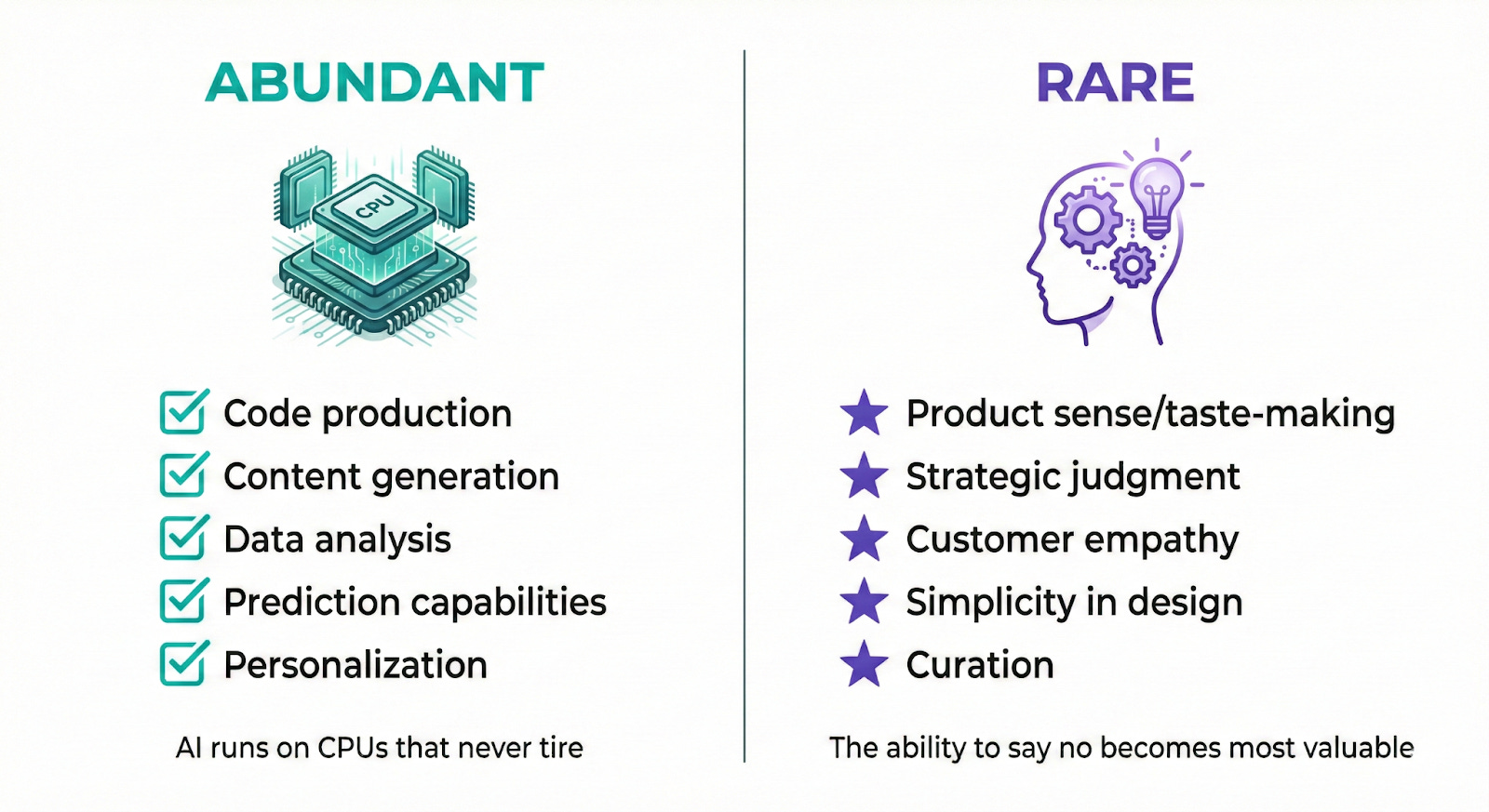
Everything tied to the five AI building blocks (content generation, natural language interaction, data synthesis, personalization and autonomy) is becoming abundant. These capabilities run on CPUs that never tire, never complain, never need vacation.
But everything that is not easily replaced by these capabilities—politics, chemistry, biology, theater, human psychology, taste-making, judgment—becomes more valuable. The human arts become rarer and more important.
This is one of our bets for the next decade.
We’re not heading toward a world where AI does everything. We’re heading toward a world where AI does a specific set of things extremely well, making human judgment in other domains exponentially more valuable.
The Bottom Line
Here’s what we keep coming back to: In an era where anyone can code anything, the ability to say “no” becomes the scarcest and most valuable skill.
This isn’t the future. This is happening right now. The numbers are clear. The patterns are emerging. The imbalance is real.
The question is: are you preparing for it?
What This Means for You
If you’re a product leader with an AI-tooled eng team:
Stop optimizing for code velocity. It’s no longer the constraint. Optimize for customer insight, strategic clarity, and judgment quality.
Build gatekeeping mechanisms now. Before the CEO walks in with an overnight feature, establish clear decision criteria and review processes.
Invest in product sense. It’s no longer a nice-to-have soft skill. It’s becoming the primary value of product management.
Think about the absorption rate. Your customers can’t absorb changes as fast as you can ship them. Build that into your planning.
If you’re a founder:
Don’t confuse building speed with market readiness. The hard part isn’t code anymore—it’s figuring out what people actually want and will pay for.
Use your infinite code capacity for quality, not quantity. Polish matters more when everyone can ship quickly.
Hire for judgment, not just execution. The person who knows what not to build is worth more than the person who can build anything.
If you’re an investor:
Look for teams with strong product judgment, not just engineering velocity. Speed to ship is becoming table stakes. Knowing what to ship is the new edge.
Watch for organizations getting overwhelmed by their own building capacity. It’s a leading indicator of future problems.
🔍 Want to dive deeper?
Check out our book BUILDING ROCKETSHIPS 🚀 and continue this and other conversations in our 💬 ProductMind Slack community and our LinkedIn community.
🎧 Prefer to listen? Check our podcast below ↓
🎥 YouTube → Click Here
🎵 Spotify → Click Here
🎙️ Apple Podcasts →Click Here
Love this post. I've been writing on this theme for a few weeks now too over here on Substack as well as over jeffgothelf.com/blog. This is such an important topic and I think, for now, it's still largely being ignored by leaders. Very happy to see you folks writing on this.