
Microsoft Is The Canary In The AI-Adoption Coal Mine
Microsoft pulls back a bit. Will others follow? An early adoption reality check is in progress.



We believe AI tools will transform knowledge work, and we’ve seen real productivity gains in specific contexts with dozens of teams we’ve worked with. Full stop.
But it’s important that Microsoft’s own research team just published a paper showing LLMs corrupt 25% of documents during delegated workflows
This is the same Microsoft that six months ago rolled out Claude Code to thousands of internal developers with great fanfare, only to quietly cancel those licenses in May 2026 for ONLY “fiscal year” reasons. Now their research division is warning that long-horizon AI delegation remains an open engineering problem to fix slow, insidious data corruption. The two things may not be related, but it does make you wonder.
Overall, we’re starting to see a healthier dose of realism in AI workforce adoption, as the edges of reliability of these new sets of tools and how it’s integrated into the workforce, are explored in more detail.
Let’s talk about the implications of Microsoft Research’s new findings.
Quality In, nice looking corruption out
The results in the paper Microsoft Research published are discouraging. They tested 19 LLMs across 52 professional domains (extremely broad, not just coding) and simulated long-running delegated workflows where you hand off document editing to AI. This BTW is exactly how everyone claims AI will replace most people - long-running iterative work.
They found that even frontier models (Gemini 3.1 Pro, Claude 4.6 Opus, GPT 5.4) corrupt an average of 25% of document content by the end of long workflows. Other models fail more severely. The errors are sparse but severe. They silently corrupt documents and this can compound over long interactions - exactly like humans playing telephone. Even worse, advanced models hallucinated and distorted rather than simply deleting things, making it more difficult for humans to determine that the content was actually wrong.
The degradation gets worse with document size, longer interactions, and the presence of distractor files. Surprisingly, agentic tool use didn’t improve performance i.e. memory and persistence did not help.
This is a “your deliverable is subtly wrong, and nobody will until it costs you money” problem, and until this is addressed, the most common workflow, document management/processing, will need significant human quality steps (Ugh!, even saying it makes us twinge). We’re looking at a seriously documented case of Quality in, Garbage out.
Microsoft’s Claude Code rollback
In December 2025, Microsoft gave thousands of employees across its Experiences and Devices division (Windows, Office, Teams, Surface) access to Claude Code. The goal was to let non-developers prototype with AI and let serious engineers compare Claude Code against GitHub Copilot head-to-head.
Claude Code became wildly popular. According to The Verge, it was “perhaps a little too popular.” Engineers preferred Anthropic’s tool over Microsoft’s own GitHub Copilot CLI. Internal adoption was strong. Usage was high.
On May 14, 2026, Microsoft began rolling back the experiment. By June 30 (end of fiscal year), most Claude Code licenses are being canceled and developers are being moved to GitHub Copilot CLI whether they like it or not.
The official reason is “toolchain unification.” The coterie of emerging reasons are more interesting.
Token-based billing consumed the annual AI budget far too quickly. The moment Microsoft switched from flat-seat licenses to usage-based pricing, the actual cost became visible and unmanageable. Large-scale adopters like Uber and others are seeing this pattern.
Also, Microsoft’s own tool was being ignored in favor of the competitor, which is a bit embarrassing when you’re Microsoft, and you own and sell GitHub Co-pilot
So which is it? Is AI so valuable that Microsoft rolled it out to thousands of internal developers, or so expensive and unreliable that they pulled it back six months later?
Real-world productivity research is mixed
The 10x developer productivity projection looks like it will take a lot more model and agentic innovation to materialize. The narrative is definitely cracking.
METR’s February 2026 data indicates a reversal of the initial 19% productivity slowdown for experienced developers, resulting in an 18% net speedup as automation intuition improves. A new cohort of developers also realized a 4% speedup. Overall developers were consistently over estimating their productivity gains but also adapting to the new tools quickly, especially parallel work.
Google’s enterprise study found 21% productivity gains, but with lower quality bars, integrated tools, and corporate tasks. Microsoft’s own 2025 study found that leaning too heavily on AI is associated with weaker critical thinking.
This is all before we talk about cognitive overload and brain fry, which limit humans’ ability to use agents.
Oh, and the Gen Z revolt is happening
Here’s what else is happening: A Gallup survey from April 2026 shows Gen Z anger toward AI jumped from 22% to 31% in one year. Excitement dropped 14 points. Hopefulness dropped 9 points. Weekly adoption growth has stalled at 51%, up only 4 points year over year.
The belief that AI helps them work faster has declined 10 points since 2025.
A Writer and Workplace Intelligence survey of 2,400 knowledge workers found 29% of employees admit to actively sabotaging their company’s AI strategy! Among Gen Z workers specifically, the sabotage rate jumps to 44%. They’re ignoring guidelines, refusing training, and deliberately skewing performance data.
This isn’t irrational technophobia. This is a verdict. Gen Z unemployment for recent college grads hit 5.7% in Q4 2025, above the national rate. Underemployment sits at 42.5%, the highest since 2020. Over half of college students say their school discourages or bans AI use, while employers demand AI literacy from day one. They’re being told AI will take their jobs while simultaneously being told they’re not prepared to use AI at work.
The resentment makes perfect sense, and so does the loud booing at multiple commencements.
The conclusion in the teal leaves
Let’s connect the dots. Microsoft rolled out Claude Code internally in December 2025 with enthusiasm. By May 2026, they’re canceling licenses due to budget overruns and low adoption of their own competing tool. And by the by, Microsoft Research publishes findings that AI delegation corrupts documents at scale. Meanwhile, worker sentiment is collapsing, productivity research is contradictory, and Gen Z is actively sabotaging AI rollouts.
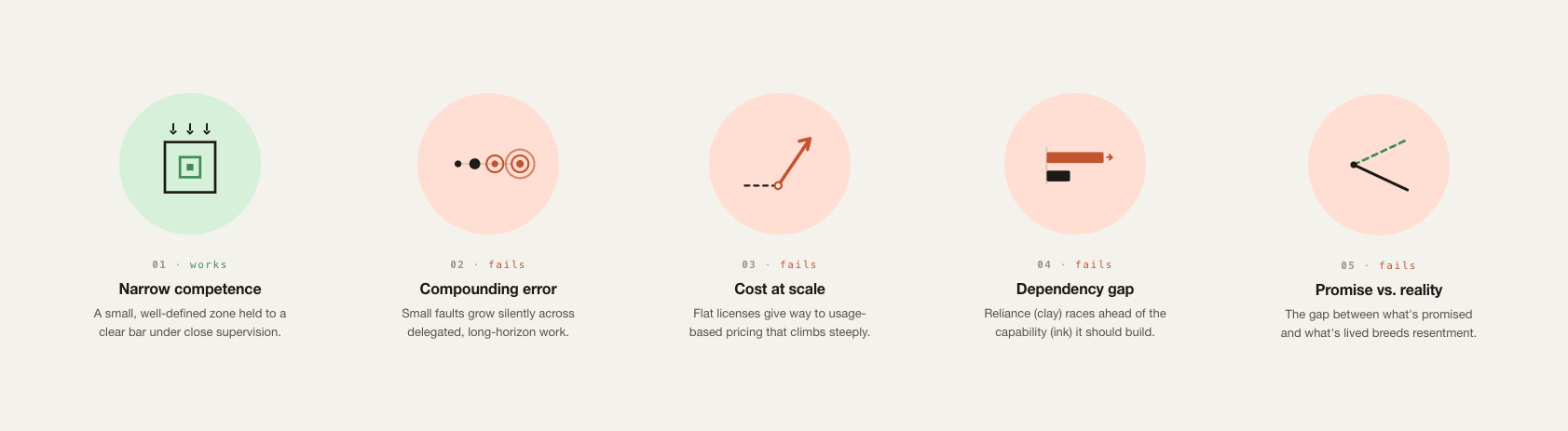
Multiple signals are pointing at the same underlying reality for the current generation of models and agentic harnesses:
They work in narrow, well-defined contexts with high supervision and clear quality bars. They fail in complex, delegated, long-horizon workflows where errors compound silently and where companies don’t provide enough guidance on implementation. They’re expensive at scale when you switch from flat licenses to usage-based pricing. They create dependency faster than capability. And the people being told to use them are increasingly resentful because the promises don’t match the reality they’re experiencing.
Microsoft is the canary because they’re the biggest enterprise AI customer, the biggest AI infrastructure provider, and one of the leading AI research organizations. When they roll something out and pull it back six months later while publishing research showing fundamental reliability problems, that’s not a product decision. That’s a real signal.
What This Means Going Forward
Lots of things jump out at us that the signal implies:
First, we need an honest accounting of the cost of adoption and weaving AI deep into the enterprise. Token-based billing creates budget exposure that most procurement teams can’t forecast or cap. If Microsoft, with near-unlimited resources, hits this wall, every enterprise will hit it. The pricing models need to change, or adoption will keep hitting fiscal-year boundaries and getting canceled.
Second, we need to stop treating delegation as solved. The Microsoft Research paper is clear. Current LLMs are unreliable delegates. They introduce sparse but severe errors that silently corrupt work artifacts. You really can’t hand off complex document editing, where correctness matters, to AI and trust the output without human review.
Third, we need to acknowledge the human capital problem. You can’t tell an entire generation their jobs are being automated while simultaneously failing to prepare them to use AI and expecting enthusiasm. The Gen Z revolt isn’t irrational. It’s a rational response to mixed signals, broken promises, and genuine career risk.
Fourth, we need better integration and measurement. The gap between benchmarks and field studies suggests we’re measuring the wrong things. AI that works in controlled settings fails in production because production has implicit quality standards, context requirements, and compounding error risks that benchmarks don’t capture.
Microsoft isn’t abandoning AI. They’re adjusting to reality. Claude models are still available through Copilot CLI and Microsoft Foundry. The research continues. The partnership with Anthropic will expand (and maybe they will throw Microsoft a bone), but the easy narrative where you just roll out AI tools and productivity soars is becoming nuanced. Integration will take more work than some assumed.
We believe AI will transform knowledge work. We’ve seen it work in the right contexts with the right support. But transformation requires honest assessment of what works and what doesn’t, not just repeating benchmarks and ignoring field evidence.
🔍 Are you a builder or a technology leader?
Check out our books BUILDING ROCKETSHIPS 🚀 and the new Ageless Peak Performance. Continue this and other conversations in our 💬 ProductMind Slack community and our LinkedIn community.